Imagine your gaming rig or powerful workstation suddenly grinding to a halt, its fans whirring like a jet engine before a dreaded “thermal shutdown.” That’s the nightmare scenario when your Graphics Processing Unit (GPU) gets too hot to handle. Choosing the right way to keep your GPU cool can feel like navigating a maze. You see all sorts of coolers, from simple fans to complex liquid systems, and wonder which one is truly the best for your needs and your wallet.
This isn’t just about preventing a crash; it’s about unlocking your GPU’s full potential and making your computer last longer. Overheating can slow down your games, mess up your creative projects, and even shorten the lifespan of your expensive hardware. If you’ve ever felt overwhelmed by the jargon or unsure if you’re getting the most bang for your buck when it comes to GPU cooling, you’re in the right place.
By the end of this post, you’ll have a much clearer picture of the different GPU cooling methods available. We’ll break down what makes each one tick, their pros and cons, and how to pick the perfect solution to keep your GPU running smoothly and quietly. Get ready to say goodbye to overheating worries and hello to peak performance.
Top Cooling Gpu Recommendations

- Excellent thermal conductivity: Made of thermal silica gel with heat conductivity of 6.0 W/Mk
- Great safety and stability: electrical insulation, in -40 ℃ - 200 ℃ will not melt. Wear Resistant, anti static, fire retardant, buffering, no toxic, odorless, no corrosion, no stimulation, no damage to metal materials
- Fits for Control board, motor, electronics, auto mechanics, computer host, laptop, DVD, VCD, LID, Set-top box, LED IC SMD DIP and any cooling modules
- Packed with 6 thermal pads, three sizes, each with 2 pieces: 20x67x0.5mm, 20x67x1.0mm, 20x67x1.5mm

- Excellent thermal conductivity: Made of thermal silica gel with heat conductivity of 6.0 W/mK
- Reliable & Durable: High temperature performance in -40 ℃ - 200 ℃ will not melt, non-toxic, odorless, anti-corrosion, wear resistant, anti-static, fire retardant, compression, good insulation, contact with any electrical traces wouldn’t result in damage of any sort.
- Application: Thermal Pad used in the control board of electronic and electrical products;Pads and foot pads inside and outside the motor; Appliances, automotive machinery, computer hosts, notebook computers, DVDs, VCDs, and any materials that require filling and cooling modules.
- Convenient & Affordable - Dimension 100x100mm, the thermal pads can be cut freely according to your needs. 0.5mm,1mm,1.5mm,2mm/set can meet different needs.

- 2 x 92mm fans combined into one interface, can be connected to the motherboard's 3-pin or 4-pin interface and you only need to access one interface to run all the fans
- This cooling fan's total size is 7.36in(L) x 4.72in(W) x 1.18in(H), designed for most universal graphic card video card VGA cooling,just please check the size to make sure your pc has enough space
- D-type interface cable included four interfaces, three voltages: 5V, 7V and 12V; different voltages with different airflow, speed and noise. You can select the appropriate voltage interface to start the fan
- The double ball bearing has a service life of 65,000 hours, and the 7 blades produce strong airflow to keep the computer case cool
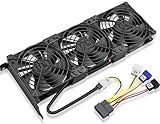
- Package include: 1 Piece Graphic Card Fans ( 3-Fans connected ) with 1*Power D-type Interface cable
- Dimension: 92mm(L) x 92mm(W) x 25mm(H) / 3.62in(L) x 3.62in(W) x 1in(H) in per fan. Totally Size: 276mm(L) x 120mm(W) x 30mm(H) / 10.86in(L) x 4.72in(W) x 1.18in(H)
- Rated Voltage: DC 12V; Rated Current: 0.45Amp; Rated Speed: 3x 1800 RPM; Air flow: 3x 39.8 CFM; Noise: 3x 24.8 dBA
- D-type interface cable included four interfaces, three voltages: 5V 7V and 12V; Different voltages with different airflow, speed, and noise. you can select the appropriate voltage interface to start the fan.

- CONSISTENT QUALITY: Our thermal paste packaging design has evolved over time, but the formula has remained the same, ensuring reliable performance.
- EXCELLENT PERFORMANCE: ARCTIC MX-4 thermal paste is made of carbon microparticles, guaranteeing extremely high thermal conductivity. This ensures that heat from the CPU/GPU is dissipated quickly & efficiently
- SAFE APPLICATION: The MX-4 is metal-free and non-electrical conductive which eliminates any risks of causing short circuit, adding more protection to the CPU and VGA cards
- HIGH DURABILITY: In contrast to metal and silicon thermal compound, the MX-4 does not compromise over time. Once applied, you do not need to apply it again as it will last at least for 8 years

- Visual Alert System: A multi-color LED ring provides real-time visual feedback, changing status when abnormal current conditions are detected for quick identification.
- RTX 4000 & 5000 Series Support – GPU Shield Adapter Cable is compatible for NVIDIA GeForce graphics cards.
- Audible Warning System: An integrated alarm sounds when abnormal current is detected, providing immediate notification even when the visual indicator is out of sight.
- Active Safety Protection: During severe electrical abnormalities, the protection mechanism automatically activates and reduces system power consumption to 0W to help prevent further damage.

- Enhances overall system heat dissipation or cool air intake efficiency
- Sturdy all steel construction
- Includes one 120mm cooling fan and a protective fan grill
- Mounts to rear expansion (PCIe) slots on new generation cases with uninterrupted opening

- [Easy to Install]: Equipped with 3 92MM long-life double ball fans, PCI design, easy to assemble and use.
- [PWM]: The fan can connect to the sys_fan interface and cpu_fan interface of the motherboard both. Allows dynamic adjustment of speed to minimize noise or maximize airflow.
- [PWM Cable]: With 4-pin PWM fan distribution extension cable, it perfectly solves the problem of no interface on the motherboard.
- [Multiple Protection]: The black metal mesh cover on the side of the fan can protect your hands and prevent cable from getting entangled.
Your Ultimate Guide to Cooling Your GPU
Is your computer getting too hot when you play games or do demanding tasks? A cool GPU (Graphics Processing Unit) is super important for your computer to work well. This guide will help you pick the best way to keep your GPU chill.
Why Cooling Your GPU Matters
Your GPU works hard. When it gets too hot, it can slow down, freeze up, or even get damaged. Good cooling keeps your GPU running fast and healthy for a long time.
Key Features to Look For
1. Type of Cooler
- Air Coolers: These use fans and metal fins. They are common and usually cheaper.
- Liquid Coolers (AIOs): These use a liquid to move heat away. They are quieter and often cool better, but cost more.
2. Fan Size and Speed
Bigger fans move more air. Faster fans cool better but can be louder. Look for a good balance.
3. Heat Sink Material
The metal part that touches the GPU is the heat sink. Copper is the best at moving heat. Aluminum is good too, but not as great as copper.
4. Noise Level
Some coolers are loud. Check reviews for noise ratings. You want a cool GPU without a noisy fan.
5. Compatibility
Make sure the cooler fits your computer case and your specific GPU model. Not all coolers work with all GPUs.
Important Materials
1. Copper
Copper is a super conductor of heat. Many high-quality heat sinks use copper to pull heat away from the GPU quickly.
2. Aluminum
Aluminum is lighter and cheaper than copper. It’s still good at cooling and you find it in many GPU coolers.
3. Thermal Paste
This is a special paste you put between the GPU and the cooler. It fills tiny gaps so heat moves smoothly. Good thermal paste is key!
Factors That Improve or Reduce Quality
1. Design and Build Quality
A well-built cooler with sturdy parts will last longer. Fancy designs can look cool and help airflow.
2. Number of Heat Pipes
Heat pipes help move heat from the GPU to the fins. More heat pipes usually mean better cooling.
3. Fan Quality
Good fans are quiet and durable. Cheap fans can break or get noisy quickly.
4. Installation Ease
A cooler that’s easy to install saves you time and frustration. Clear instructions help a lot.
User Experience and Use Cases
For Gamers
If you play demanding games, you need strong cooling. Liquid coolers or big air coolers are great choices. They keep your game running smoothly without lag.
For Content Creators
Video editing and 3D rendering make your GPU work hard. Good cooling helps these tasks finish faster. It prevents your computer from slowing down.
For Everyday Users
Even if you just browse the web or watch videos, a cooler GPU means your computer runs better. It can make your computer last longer too.
Frequently Asked Questions (FAQ)
Q: What is the most important thing to consider when buying a GPU cooler?
A: Compatibility with your GPU and computer case is the most important. You also want good cooling performance.
Q: Are liquid coolers better than air coolers?
A: Liquid coolers often offer better cooling and are quieter, but they cost more. Air coolers are a good budget-friendly option.
Q: How often do I need to replace thermal paste?
A: You should replace thermal paste every few years, or if you remove the cooler.
Q: Will a better GPU cooler make my computer faster?
A: Yes, if your GPU was overheating and slowing down, better cooling will help it perform at its best.
Q: Can I install a GPU cooler myself?
A: Yes, many coolers are designed for easy DIY installation. Just follow the instructions carefully.
Q: What does “TDP” mean for a GPU cooler?
A: TDP (Thermal Design Power) is the maximum amount of heat a cooler can handle. Make sure the cooler’s TDP is higher than your GPU’s TDP.
Q: Are RGB lights on GPU coolers important?
A: RGB lights are for looks. They don’t affect cooling performance.
Q: How do I know if my GPU is overheating?
A: Your computer might slow down, freeze, or show graphical glitches. You can also use software to check temperatures.
Q: What’s the difference between an AIO cooler and a custom liquid cooling loop?
A: An AIO (All-In-One) is a pre-built, easy-to-install liquid cooler. A custom loop is built piece by piece and offers more control and performance but is more complex.
Q: Should I upgrade my GPU cooler if I’m not gaming?
A: If you do demanding tasks like video editing, a cooler upgrade can still be very beneficial for performance and longevity.

Hi, I’m Mallory Crusta, the heart and mind behind LovelyPetSpot.com.. As a passionate pet enthusiast, I created this space to share my experiences, expertise, and love for all things pets. Whether it’s helpful tips, heartfelt stories, or advice for pet parents, my mission is to make the journey of caring for your furry, feathery, or scaly friends as joyful and fulfilling as possible. Join me in celebrating the incredible bond we share with our animal companions!