As an Amazon Associate I earn from qualifying purchases.
Improving your golf swing at home can be difficult without clear feedback. You may want to fix your grip, build tempo, improve connection or see your swing path, but each problem calls for a different type of training aid.
When choosing, focus on the movement you want to rehearse, how much space you have and whether you need a compact drill tool or a full-length trainer. Safety and versatility also matter if you plan to practise indoors.
These picks were selected from the listed features, with priority given to distinct training purposes rather than colour or size variations. They cover grip work, swing rhythm, connection, speed development and visible path feedback.
This guide explains what sets each aid apart, who it suits best and the trade-offs to consider before choosing one.
Our Top 5 Golf Swing Training Aids Picks at a Glance
| Product | ||
|---|---|---|
 |
Orange Whip Golf Swing Trainer Tempo and warm-up practice |
Check Price |
 |
FODESAN Retractable Golf Swing Trainer Beginners learning grip and tempo |
Check Price |
 |
COSPOPTIC Golf Hitting Mat Visible swing-path feedback |
Check Price |
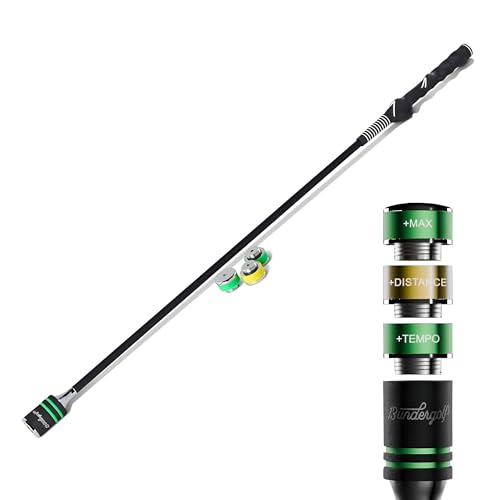 |
13 Under Golf TA25 Weighted Trainer Progressive speed and lag training |
Check Price |
 |
Tour Striker Smart Ball Arm and body connection |
Check Price |
Top 5 Golf Swing Training Aids: Detailed Reviews
1. Orange Whip Golf Swing Trainer
The Orange Whip Golf Swing Trainer is a 47-inch Golf Swing Training Aid built around a patented counterbalanced design that combines rhythm, flexibility and balance feedback. Its flexible shaft coordinates the movement of your arms, upper body and lower body as you swing continuously back and through. A wobbling sensation gives immediate feedback that your tempo, balance or swing plane needs attention. It can also help warm up your golf muscles before play, while the handmade-in-the-USA construction with American parts adds a quality-focused touch.
What We Like:
- The counterbalanced design helps you feel smoother rhythm and better coordination.
- The flexible shaft links arm, upper-body and lower-body movement during practice.
- Wobbling provides immediate, easy-to-understand feedback on balance and tempo.
- Continuous swings make it useful for warm-ups before a round.
- Its 47-inch length gives you a substantial training tool without using a golf ball.
What Could Be Improved:
- The feedback is based on feel, so it will not give you measured swing data.
- It focuses on rhythm, balance and coordination rather than showing ball flight or clubface results.
- Its flexible design may require an adjustment if you expect a conventional club-like feel.
Buy it if you want a simple home or pre-round tool for rhythm, flexibility, balance and athletic movement. It suits golfers who value feel-based feedback and warm-up practice. Skip it if you need measured swing analysis, ball-flight feedback or a training aid that closely replicates a standard club.
2. FODESAN Retractable Golf Swing Trainer
Golf Swing Training Aids such as the FODESAN Retractable Golf Swing Trainer give you a simple way to rehearse fundamentals without hitting a ball. This retractable format pairs a right-handed grip trainer with click feedback, so you can practise hand and finger placement while developing a repeatable tempo. Its stainless steel shaft, reinforced resin head and non-slip rubber grip support regular indoor or outdoor use. You can use it for warm-ups, beginner mechanics or ongoing tempo work, and the compact, no-ball format makes practice easy to fit into your routine.
What We Like:
- The right-handed grip trainer helps you practise consistent hand and finger placement.
- Click feedback gives you an immediate cue for tempo practice.
- You can practise indoors or outdoors without a ball.
- The retractable design suits convenient, anytime practice.
- The stainless steel shaft and reinforced resin head are built for repeated use.
What Could Be Improved:
- It is designed for right-handed golfers, so left-handed players should skip it.
- Click feedback focuses on timing and tempo rather than showing ball flight or swing-path results.
- Beginners may still need instruction to confirm that their grip and mechanics are correct.
Buy it if you are a right-handed golfer who wants convenient grip and tempo practice at home, before a round or outdoors. It suits beginners especially well, while experienced players can use it for reinforcement. Skip it if you need ball-flight feedback, swing-path information or left-handed compatibility.
3. COSPOPTIC Golf Hitting Mat
Golf Swing Training Aids such as the COSPOPTIC Golf Hitting Mat give you a compact way to practise swing path indoors or outdoors. Its impact surface visibly traces toe, center, or heel strikes, helping you see where the club is contacting rather than relying on feel alone. The textured heavy-duty rubber base grips flat floors and stays in place during swings. At 16×12 inches, it is lightweight enough to carry between a garage, patio, office, or yard. It also includes a spare velvet turf surface for longer use and reduced club-face wear.
What We Like:
- The visible strike marks make toe, center, and heel contact easy to identify.
- The textured rubber backing helps prevent movement during swings.
- The compact, lightweight design suits practice at home, in a garage, or outdoors.
- The spare velvet turf surface extends the mat’s useful life.
- It lets you practise without visiting a driving range.
What Could Be Improved:
- The 16×12-inch footprint is compact, so it may not suit drills requiring a larger stance or hitting area.
- You need a flat surface to use the mat as intended.
- Its feedback focuses on impact location, so it will not show every part of your swing mechanics.
Buy this if you want portable Golf Swing Training Aids with clear visual feedback on toe, center, and heel contact. It suits quick home or garage drills, especially when mat stability matters. Skip it if you need a full-size practice area or feedback covering more than the club’s impact location.
4. 13 Under Golf TA25 Weighted Trainer
The 13 Under Golf TA25 is one of the more adjustable Golf Swing Training Aids for home practice, combining a molded neutral grip with a flexible fiberglass shaft and three screw-in 100 g weights. Use the +100 g setting for tempo, +200 g for distance, or +300 g for maximum loading. In practice, the changing resistance lets you shift from smooth sequencing to lag and speed work, while the bending shaft gives immediate feedback when you rush or cast. At 40 inches, it also fits a standard golf bag for warm-ups.
What We Like:
- Three stackable weights let you change the training emphasis.
- The molded grip reinforces a repeatable neutral hand position.
- The flexible shaft helps you feel rushed tempo and casting.
- Progressive loading supports lag and swing-speed practice.
- Its 40-inch length fits in a standard golf bag.
What Could Be Improved:
- Changing the screw-in weights takes more setup than using a fixed trainer.
- The molded grip may feel restrictive if you are working on a different grip position.
- The California Proposition 65 warning may concern some buyers.
Buy it if you want one compact trainer for grip, tempo, lag, and speed work, especially if you value adjustable resistance and course warm-ups. Skip it if you prefer a simple fixed-weight aid or need highly specific grip experimentation beyond its molded neutral position.
5. Tour Striker Smart Ball
Golf Swing Training Aids such as the Tour Striker Smart Ball give you a compact way to practise arm-body connection during structured swings. Its patented design helps keep your arms and body working together through takeaway, transition, and follow-through. You can use it with wedges, irons, fairway woods, driver, and putter drills to rehearse sequencing, tempo, body rotation, an inside path, and cleaner contact. That makes it useful for building swing awareness and coordination, though it works best when you follow deliberate drills rather than simply hitting balls.
What We Like:
- It reinforces arm and body connection through key swing phases.
- You can use it across wedges, irons, fairway woods, driver, and putter practice.
- It supports drills focused on tempo, sequencing, and body rotation.
- It helps you rehearse an inside path and cleaner contact.
- Its compact format suits structured practice sessions at home or on the range.
What Could Be Improved:
- It requires deliberate drills, so it will not provide much benefit as a passive training aid.
- It supports swing-feel practice but does not replace feedback from a coach or launch monitor.
- You may need to adapt your practice routine to use it consistently across different clubs.
Buy it if you want a compact aid for connection drills and repeatable movement patterns across your whole set. It suits golfers willing to practise deliberately. Skip it if you want instant swing data, automated feedback, or a training tool that works without focused repetition.
How To Choose Golf Swing Training Aids
Golf Swing Training Aids work best when they match the part of your swing you want to improve. Before you buy, identify whether you need help with tempo, grip, swing path, speed, lag, or the connection between your arms and body. A focused tool is usually more useful than one that promises to fix everything.
Golf Swing Training Aids and your practice goal
Start with the feedback you can use immediately. If your timing feels inconsistent, choose an aid that helps you repeat a steady rhythm; if you struggle to understand your path, prioritise something that makes that movement easier to see or feel.
Also consider your experience level. A beginner may benefit from a simple aid that reinforces basic positions, while a more experienced golfer may want resistance, added weight, or a way to work on speed and lag.
Feedback you can understand
The best training aid gives you a clear signal when you make the intended movement. That signal might be a change in feel, a visible mark or path, or a difference in how the club or your body moves.
Avoid buying based only on how technical a product sounds. If you cannot tell what to do differently after each repetition, the aid may add activity without adding useful practice.
Space, setup, and convenience
Check where you plan to practise and how much preparation you will tolerate. A tool that works in a small indoor area may suit frequent practice better than one that needs more room, while a hitting-focused aid may require a suitable surface and enough clearance for safe swings.
Think about storage and setup time too. The easier an aid is to reach and use, the more likely you are to practise consistently rather than leave it unused between sessions.
Progression and long-term value
Choose an aid that still has a role after your first few sessions. Adjustable resistance, a progression from slower movements to faster ones, or feedback that remains useful as your technique improves can make a purchase more worthwhile.
Do not ignore comfort and control. You should be able to complete repeated practice without forcing a movement or losing balance, and the aid should support your swing rather than encourage compensation. The right choice is the one that fits your goal, space, experience, and willingness to practise regularly.
Which Golf Swing Training Aid Should You Choose?
The Orange Whip Golf Swing Trainer is the best overall pick because it targets tempo and warm-up practice, two useful needs for many golfers. The Tour Striker Smart Ball is the best alternative if your priority is keeping your arms and body connected during the swing. Choose the FODESAN for beginner-focused grip and tempo work, the COSPOPTIC for visible swing-path feedback, or the 13 Under Golf TA25 for progressive speed and lag training.

Hi, I’m Mallory Crusta, the heart and mind behind LovelyPetSpot.com.. As a passionate pet enthusiast, I created this space to share my experiences, expertise, and love for all things pets. Whether it’s helpful tips, heartfelt stories, or advice for pet parents, my mission is to make the journey of caring for your furry, feathery, or scaly friends as joyful and fulfilling as possible. Join me in celebrating the incredible bond we share with our animal companions!