As an Amazon Associate I earn from qualifying purchases.
Choosing a Wifi Card For Pc can be confusing when you are weighing PCIe cards, USB adapters, Wi-Fi generations, and antenna designs. The right option depends on your desktop, router, connection demands, and whether you also need Bluetooth.
Start with the wireless standard and band support. Wi-Fi 7 and Wi-Fi 6E offer newer tri-band capabilities, while Wi-Fi 6 cards cover most modern desktop upgrades. Antenna placement also matters, especially if your PC sits under a desk or far from the router.
These picks were selected from the listed features, with attention to speed tiers, Wi-Fi bands, Bluetooth versions, antenna design, and installation format. They cover high-performance upgrades, flexible 6 GHz networking, mainstream PCIe value, and simple USB connectivity.
Below, you will find the strongest overall option first, followed by alternatives for different networks, desktops, and budgets.
Our Top 5 Wifi Card For Pc Picks at a Glance
| Product | ||
|---|---|---|
 |
TP-Link BE9300 Wi-Fi 7 PCIe Card Maximum desktop performance |
Check Price |
 |
TP-Link BE9300 Wi-Fi 7 PCIe Card with Base Flexible Wi-Fi 7 placement |
Check Price |
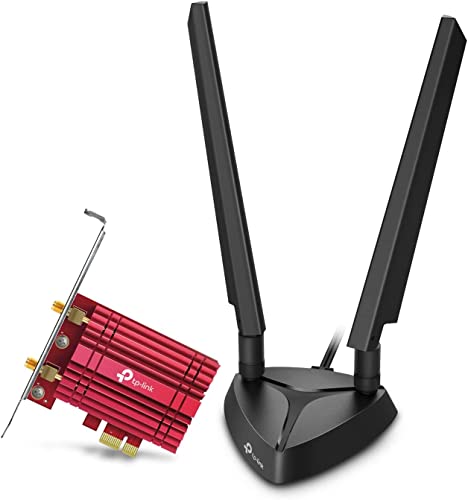 |
TP-Link AXE5400 Wi-Fi 6E PCIe Card 6 GHz networking |
Check Price |
 |
TP-Link AX3000 Wi-Fi 6 PCIe Card Mainstream Wi-Fi 6 upgrades |
Check Price |
 |
TP-Link AC600 USB Wi-Fi Adapter Simple USB connectivity |
Check Price |
Top 5 Wifi Card For Pc: Detailed Reviews
1. TP-Link BE9300 Wi-Fi 7 PCIe Card
The TP-Link BE9300 is a top-end Wifi Card For Pc with Wi-Fi 7, tri-band support, and Bluetooth 5.4. It supports up to 5,764 Mbps on 6 GHz, 2,882 Mbps on 5 GHz, and 688 Mbps on 2.4 GHz, while 320 MHz channels can double 6 GHz bandwidth with a compatible Wi-Fi 7 router. MLO combines bands for better throughput, latency, and reliability. OFDMA and MU-MIMO help manage multiple connected devices, and the two high-gain antennas improve reception across your desktop’s wireless range.
What We Like:
- Wi-Fi 7 and 320 MHz support provide substantial capacity with a compatible router.
- MLO can improve throughput, latency, and connection reliability on Wi-Fi 7 networks.
- Tri-band operation supports 6 GHz, 5 GHz, and 2.4 GHz connections.
- Bluetooth 5.4 adds newer wireless connectivity for compatible peripherals.
- High-gain antennas can improve reception when your desktop sits farther from the router.
What Could Be Improved:
- You need a Wi-Fi 7 router to take advantage of 320 MHz channels and MLO.
- Installing a PCIe card requires an available desktop expansion slot and some setup.
- Its advanced capabilities may be unnecessary if your network uses Wi-Fi 5 or Wi-Fi 6.
Buy this card if you want a high-end desktop wireless upgrade and already use, or plan to use, a Wi-Fi 7 router. It suits demanding multi-device networks and users who need Bluetooth 5.4. Skip it if you want a simple adapter or your existing router cannot use its Wi-Fi 7 features.
2. TP-Link BE9300 Wi-Fi 7 PCIe Card with Base
The TP-Link BE9300 is a WiFi Card For Pc built for fast, flexible desktop networking. Its tri-band Wi-Fi 7 support uses the 6 GHz, 5 GHz, and 2.4 GHz bands, with speeds up to 5760 Mbps on 6 GHz and 2880 Mbps on 5 GHz. Multi-Link Operation, OFDMA, MU-MIMO, and Multi-RU are designed to reduce lag and improve reliability on busy networks. Two multidirectional antennas connect to a magnetic base, so you can position reception away from the back of your case. Bluetooth 5.4 and multicolor status lighting add convenience.
What We Like:
- Wi-Fi 7 and 6 GHz support provide room for high-bandwidth desktop networking.
- The magnetic antenna base gives you more placement flexibility than fixed rear-panel antennas.
- MLO, OFDMA, MU-MIMO, and Multi-RU target smoother gaming, streaming, and video calls.
- Tri-band connectivity lets you use 6 GHz, 5 GHz, or 2.4 GHz networks.
- Bluetooth 5.4 adds wireless-device connectivity alongside Wi-Fi.
What Could Be Improved:
- You need an available PCIe slot and a desktop installation, so it is not a quick plug-in upgrade.
- Wi-Fi 7 and 6 GHz advantages depend on having a compatible network and devices.
- The separate magnetic base needs space and a practical cable route near your PC.
Buy this card if you want a high-end desktop Wi-Fi 7 upgrade and value the freedom to place its antennas away from your PC. It suits fast networks, gaming, streaming, and busy households. Skip it if you need USB simplicity or your router does not support newer Wi-Fi features.
3. TP-Link AXE5400 Wi-Fi 6E PCIe Card
The TP-Link AXE5400 is a Wi-Fi 6E Wifi Card For Pc that adds tri-band wireless networking, including the dedicated 6 GHz band. That newer band gives you more bandwidth and can reduce congestion when your network supports it, while rated speeds reach up to 2402 Mbps on 6 GHz, 2402 Mbps on 5 GHz, and 574 Mbps on 2.4 GHz. Its two multi-directional antennas connect to a magnetic base, letting you position them for reception. Bluetooth 5.3 adds wireless accessory support, while WPA3, OFDMA, and MU-MIMO improve security and responsiveness.
What We Like:
- The dedicated 6 GHz band provides a wider, clearer option for compatible networks.
- The magnetic antenna base gives you more flexibility when positioning the antennas.
- Bluetooth 5.3 adds faster wireless connectivity with broader coverage.
- OFDMA and MU-MIMO help reduce lag on busy networks.
- WPA3 provides stronger protection for personal password security.
What Could Be Improved:
- The 6 GHz benefits depend on having a compatible Wi-Fi 6E network.
- Installing a PCIe card is less convenient than using a USB adapter.
- The magnetic base needs a suitable placement area near your desktop.
Buy it if you want a desktop Wi-Fi upgrade with 6 GHz networking, flexible antenna placement, and Bluetooth 5.3. It suits newer, busier wireless environments especially well. Skip it if you only need basic connectivity, lack a compatible 6 GHz network, or prefer the simplicity of USB installation.
4. TP-Link AX3000 Wi-Fi 6 PCIe Card
The TP-Link AX3000 is a WiFi Card For Pc that brings Wi-Fi 6 to compatible Windows 11 and 10 64-bit desktops. It offers up to 2.4Gbps across dual-band connections, with OFDMA and MU-MIMO designed to reduce lag and keep multiple devices responsive. Two high-performance antennas sit on a magnetized base, so you can position them away from the back of your computer for better reception. Bluetooth 5.3 adds wireless connectivity for compatible peripherals, while driver installation is required before use.
What We Like:
- Wi-Fi 6 delivers up to 2.4Gbps on supported connections.
- OFDMA helps reduce lag during gaming and other real-time use.
- The magnetized antenna base gives you more placement flexibility.
- Bluetooth 5.3 supports compatible wireless peripherals.
- MU-MIMO helps the connection handle multiple devices more efficiently.
What Could Be Improved:
- Driver installation is required, and you may need to download it from TP-Link if your PC lacks a CD-ROM drive.
- It supports Windows 11 and Windows 10 64-bit, so other operating systems are not covered by the stated compatibility.
- This is a dual-band Wi-Fi 6 card, not a 6 GHz Wi-Fi 6E model.
Buy it if you want a fast desktop Wi-Fi upgrade with flexible antenna placement and Bluetooth 5.3 for compatible accessories. It suits Windows 10 or 11 64-bit PCs that can accept a PCIe card. Skip it if you specifically need 6 GHz networking or support for another operating system.
5. TP-Link AC600 USB Wi-Fi Adapter
This TP-Link AC600 is a practical Wifi Card For Pc alternative for adding wireless connectivity through USB. It supports 2.4 GHz speeds up to 200 Mbps and 5 GHz speeds up to 433 Mbps, giving you a choice between broader range and faster connections. Its 5dBi high-gain antenna improves signal reception and transmission, while the rotatable, multi-directional design lets you aim it toward your router. The adapter supports 802.11ac and works with Windows 11, 10, 8.1, 8, 7, and XP, but not other operating systems.
What We Like:
- USB connectivity avoids opening your desktop case.
- Dual-band support works with both 2.4 GHz and 5 GHz networks.
- The 5dBi antenna can improve reception compared with a basic compact dongle.
- The adjustable antenna gives you more control over signal direction.
- Up to 433 Mbps on 5 GHz suits everyday browsing, streaming, and gaming needs.
What Could Be Improved:
- It supports Windows only, so it is unsuitable for macOS or Linux PCs.
- Its listed speeds are below newer Wi-Fi 6 and Wi-Fi 7 adapters.
- A USB adapter can be less tidy than an internal PCIe card on a desktop.
Buy it if you want a straightforward USB upgrade for a Windows desktop and value flexible antenna positioning over the newest wireless standards. Skip it if you need macOS or Linux support, Wi-Fi 6 or Wi-Fi 7 performance, or the clean installation of an internal PCIe adapter.
How to Choose a Wifi Card For Pc
Match the card to your network
Start by checking your router’s wireless standard before choosing a Wifi Card For Pc. A Wi-Fi 7 card makes the most sense if you already use, or plan to buy, a compatible Wi-Fi 7 router. Otherwise, a Wi-Fi 6 or Wi-Fi 6E adapter may fit your current setup more sensibly, while older routers can limit the benefit of a newer card.
Consider whether you need access to the 6 GHz band. Wi-Fi 6E hardware can use 6 GHz networking, but your router and desktop environment must support that band as well. Check local wireless regulations and network compatibility before treating 6 GHz support as a deciding factor.
Choose PCIe or USB based on your desktop
PCIe cards suit desktops with an available compatible expansion slot and offer a more permanent installation. They are a good choice when you want the adapter inside the case and do not expect to move it between computers. Before buying, confirm that your desktop has a free slot and enough room around it for installation.
A USB adapter is simpler to connect and easier to move between systems. That convenience can matter if you do not want to open the case, although the adapter will occupy a USB port and may be less tidy than an internal card. Match the connection type to how often you upgrade, relocate, or service your desktop.
Think about antenna placement
Placement can affect how easily your desktop connects to the router. If the computer sits under a desk, inside a cabinet, or near other equipment, a card with a separate base may give you more flexibility in positioning the wireless hardware. A standard internal installation may be sufficient when the desktop has a clear path to the router.
Do not choose a base or antenna arrangement without considering cable routing and desk space. A more flexible setup can be useful, but it also adds another piece to position and manage.
Check software and your upgrade plans
Confirm operating-system support and available drivers before purchasing. Also consider the life of the desktop: a newer wireless card can make sense if you plan to keep the system for several years, while a simpler adapter may be the better fit for basic browsing and everyday connectivity.
Finally, compare the improvement you expect with your internet service and local network use. Faster wireless hardware cannot make an internet connection exceed the service you receive, but it can still matter for compatible local networking and future router upgrades.
Which Wifi Card For Pc Should You Choose?
The TP-Link BE9300 Wi-Fi 7 PCIe Card is the best overall pick for maximum desktop performance and a forward-looking upgrade. If you want more placement flexibility, choose the TP-Link BE9300 Wi-Fi 7 PCIe Card with Base instead. The TP-Link AXE5400 Wi-Fi 6E PCIe Card is the best alternative for 6 GHz networking, while the AX3000 and AC600 make more sense for mainstream Wi-Fi 6 upgrades or simple USB connectivity.

Hi, I’m Mallory Crusta, the heart and mind behind LovelyPetSpot.com.. As a passionate pet enthusiast, I created this space to share my experiences, expertise, and love for all things pets. Whether it’s helpful tips, heartfelt stories, or advice for pet parents, my mission is to make the journey of caring for your furry, feathery, or scaly friends as joyful and fulfilling as possible. Join me in celebrating the incredible bond we share with our animal companions!